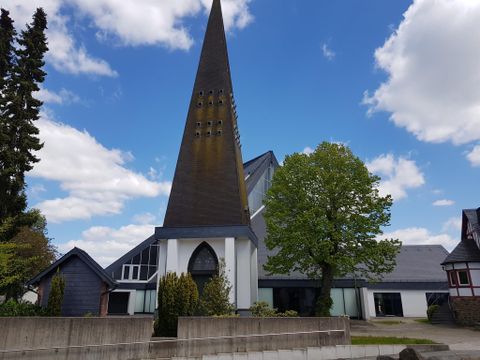
The verifiable building history of the parish church in Wanderath begins in the 13th century. The original church is Romanesque, around 1500 the late Gothic nave, today's aisle, was built with the help of the Counts of Virneburg, who were the patrons of the church. When the church was enlarged by a south and north aisle around 1530, the side walls of the old church were broken through. In 1655 Wanderath becomes an independent parish. These include the places Engeln, Büchel, Freilingen, Nitz, Ober- Mittel- and Niederbaar, Herresbach, Eschbach, Döttingen, Siebenbach and Drees. Virneburg was added at the beginning of the 19th century. For this, Drees is assigned to Welcherath. In 1896/1897 the current, neo-Gothic main nave was built. The two Gothic aisles are being demolished. In 1921/1922 the church was expanded again. The then octagonal sacristy was torn down and the current one built. The main nave was lengthened by 10 m and the gallery was built. The tower was raised by 6 meters. In addition, the church received a continuous roof area. Since then, the outward view has not changed. Since Wanderath only consisted of a church, a rectory, a school and a residential building until the middle of the 19th century, there are many legends and myths surrounding the question of why a church was built in the poor Wanderath at all.
The Kottenheimer Winfeld is a former quarry area in the area of the municipality of Kottenheim and owes its origin to the eruption of the Bellerberg volcano about 200,000 years ago. Today, the idyllic pit landscape with its bizarre rock formations and relics from bygone times, such as crane bases and pit cranes, is part of the volcano park as a landscape monument.
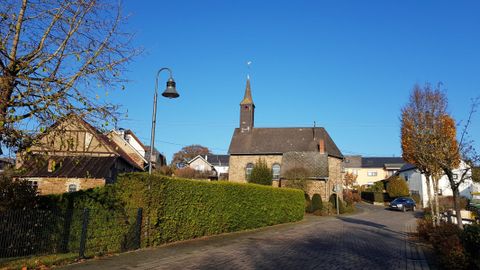
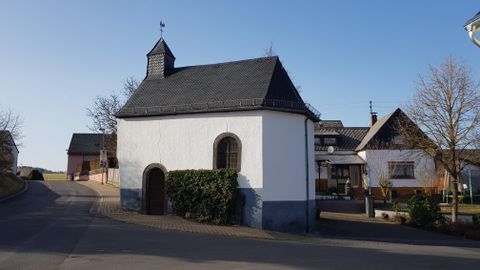
Today's St. Hubertus Chapel, built in 1826, is centrally located in the center of the community of Acht at the corner of Hauptstraße and Am Kirchweg. In recent years, the chapel has been lovingly restored as part of a large number of building measures and is now a neat eye-catcher in the middle of the village.