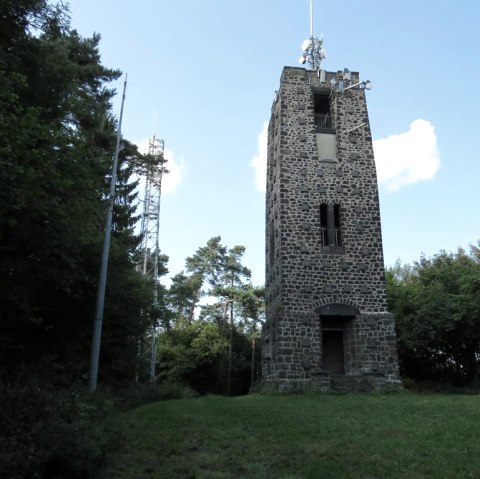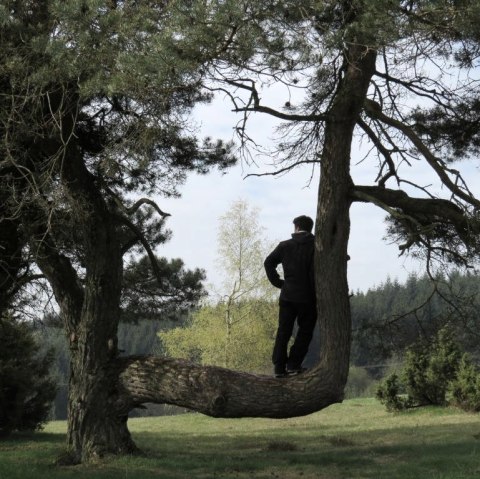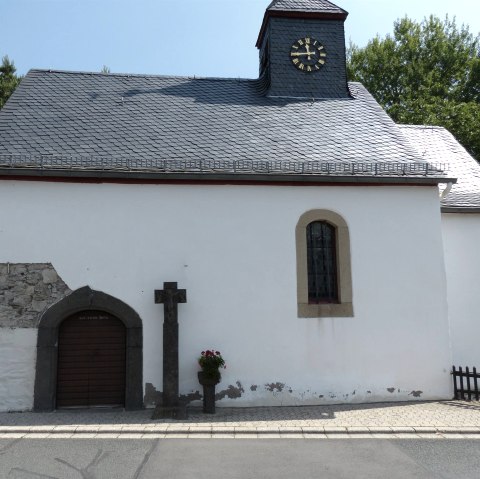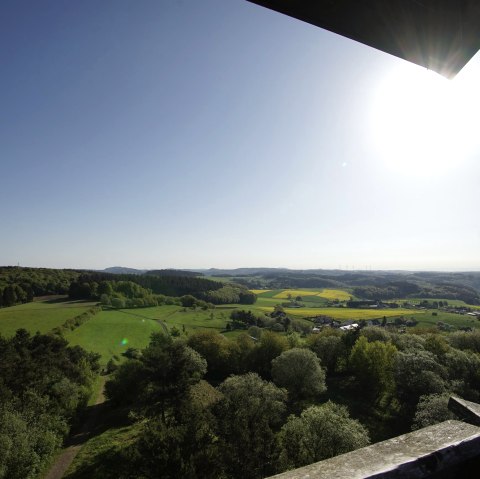

In the Ettringer Lay, © Foto: Svenja Schulze-Entrup, Quelle: Touristik-Büro Vordereifel

Ettringer Lay - Vulkanparkstation

Ettringen

About 150 years ago, the deepest quarries around the Bellerberg volcano were created in the "Ettringer Lay". The mighty stone pillars of his western lava flow were broken here, for building materials or paving stones.

Steep mining canyons and numerous legacies from the time of stone extraction make the "Lay" an impressive monument of volcanological and technical history. In the former basalt lava quarry, basalt lava walls up to 40 meters high can admire one of the three Bellerberg lava flows.

If you look at the quarry parcel with the huge basalt wall from the edge of the pit, you can guess how deep the old valley must have been before the eruption and what large amounts of hot lava flowed from the edge of the Ettringer Bellerberg. Life-size steel figures - such the "soup bearers" - scenes from the everyday life of the former stone breakers. Old pit cranes, rusted lorries and tracks still bear witness to the activity of mining until the 1970s. With its numerous technical remains from the early 20th century, the "Ettringer Lay" is a truly unique monument to the quarry history of our volcanic region, which is now used by climbers and others. 

mehr lesen

Share content:

At a glance

Opening hours

  • From January 1st to December 31st
    Monday
    00:00 - 23:59

    Tuesday
    00:00 - 23:59

    Wednesday
    00:00 - 23:59

    Thursday
    00:00 - 23:59

    Friday
    00:00 - 23:59

    Saturday
    00:00 - 23:59

    Sunday
    00:00 - 23:59

The "Ettringer Lay" can be visited year-round, depending on the weather.

Place

Ettringen

Contact

Ettringer Lay - Vulkanparkstation
L82 zw. Mayen und Ettringen
56729 Ettringen
Phone: (0049) 2651800995
Fax: (0049) 2651800920

Homepagewrite e-mail

Bitte akzeptieren Sie den Einsatz aller Cookies, um den Inhalt dieser Seite sehen zu können.

Alle Cookies Freigeben

Plan your journey

per Google Maps

You might also be interested in

St. Castor in Weiler, © Foto: Svenja Schulze-Entrup, Quelle: Touristik-Büro Vordereifel

Pfarrkirche "St. Kastor" in Weiler

The baroque church was built in 1727 as a hall building made of plastered quarry stone. After the population in Weiler grew steadily until 1906, plans for a church expansion were drawn up by baumeister Rüppel from Bonn. The church was to be extended with basalt stones by the addition of a transept and a choir room in neo-Gothic style, along with sacristy buildings. In 1909 the "new" church could be solemnly consecrated. Particularly worth seeing is the Marienaltar, which was taken over from the "old" church.

View of Wanderath, © Foto: Svenja Schulze-Entrup, Quelle: Touristik-Büro Vordereifel

Pfarrkirche St. Valerius, Baar-Wanderath

The verifiable building history of the parish church in Wanderath begins in the 13th century. The original church is Romanesque, around 1500 the late Gothic nave, today's aisle, was built with the help of the Counts of Virneburg, who were the patrons of the church. When the church was enlarged by a south and north aisle around 1530, the side walls of the old church were broken through. In 1655 Wanderath becomes an independent parish. These include the places Engeln, Büchel, Freilingen, Nitz, Ober- Mittel- and Niederbaar, Herresbach, Eschbach, Döttingen, Siebenbach and Drees. Virneburg was added at the beginning of the 19th century. For this, Drees is assigned to Welcherath. In 1896/1897 the current, neo-Gothic main nave was built. The two Gothic aisles are being demolished. In 1921/1922 the church was expanded again. The then octagonal sacristy was torn down and the current one built. The main nave was lengthened by 10 m and the gallery was built. The tower was raised by 6 meters. In addition, the church received a continuous roof area. Since then, the outward view has not changed. Since Wanderath only consisted of a church, a rectory, a school and a residential building until the middle of the 19th century, there are many legends and myths surrounding the question of why a church was built in the poor Wanderath at all.