
Otilia Kapelle im Schnee, © Verbandsgemeinde Vordereifel

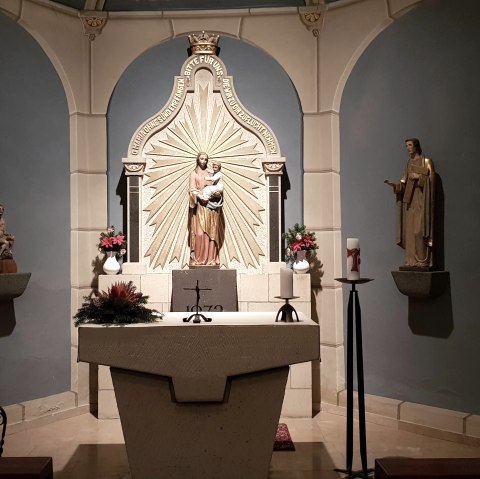
Kapelle St. Ottilia in Kirchwald

Kirchwald

The St. Ottilia chapel is somewhat hidden on the footpath to the Riedener Mühle, right on the edge of the forest. The very neat chapel was built in 1897 by a certain F.W. Hilger, for the salvation of his eyesight.

mehr lesen

Share content:

At a glance

Opening hours

  • From January 1st to December 31st
    Monday
    00:00 - 23:59

    Tuesday
    00:00 - 23:59

    Wednesday
    00:00 - 23:59

    Thursday
    00:00 - 23:59

    Friday
    00:00 - 23:59

    Saturday
    00:00 - 23:59

    Sunday
    00:00 - 23:59

The chapel of St. Ottilia can be visited all year round.

Place

Kirchwald

Contact

Ottilia Kapelle
Waldstraße
56729 Kirchwald

Bitte akzeptieren Sie den Einsatz aller Cookies, um den Inhalt dieser Seite sehen zu können.

Alle Cookies Freigeben

Plan your journey

per Google Maps

You might also be interested in

Blick auf Wanderath, © Foto: Svenja Schulze-Entrup, Quelle: Touristik-Büro Vordereifel

Pfarrkirche St. Valerius, Baar-Wanderath

The verifiable building history of the parish church in Wanderath begins in the 13th century. The original church is Romanesque, around 1500 the late Gothic nave, today's aisle, was built with the help of the Counts of Virneburg, who were the patrons of the church. When the church was enlarged by a south and north aisle around 1530, the side walls of the old church were broken through. In 1655 Wanderath becomes an independent parish. These include the places Engeln, Büchel, Freilingen, Nitz, Ober- Mittel- and Niederbaar, Herresbach, Eschbach, Döttingen, Siebenbach and Drees. Virneburg was added at the beginning of the 19th century. For this, Drees is assigned to Welcherath. In 1896/1897 the current, neo-Gothic main nave was built. The two Gothic aisles are being demolished. In 1921/1922 the church was expanded again. The then octagonal sacristy was torn down and the current one built. The main nave was lengthened by 10 m and the gallery was built. The tower was raised by 6 meters. In addition, the church received a continuous roof area. Since then, the outward view has not changed. Since Wanderath only consisted of a church, a rectory, a school and a residential building until the middle of the 19th century, there are many legends and myths surrounding the question of why a church was built in the poor Wanderath at all.